Can social media algorithms be a solution to the dreadful famine looming in Africa and the Arabic Peninsula?
by Matthieu Guillier, PAIS student in year-abroad
In this article, Matthieu takes a look at the depressing lack of Western coverage and reaction to the acute food crisis. Applying libertarian paternalism, a theory that won Richard Thaler the 2017 Nobel prize in Economics, he suggests a new way of raising awareness about humanitarian crises. The proposal would aim at increasing drastically the viewers’ amount of exposure to information pertaining to humanitarian crises, as while very few people are currently aware of the current crisis, a majority of them are strongly committed to tackling it when told about it.
An asymmetrical indignation?
On the evening of the first Sunday of October, a wave of indignation swept across Briton sitting rooms as the weekly episode of the drama series “Victoria” painted a scathing portrait of the British response to the Irish Potato Famine. After taking a quick glance at the articles reviewing the episode and the related Twitter hashtags, one might have the following intuitions about individual responses to famine and humanitarian plights [1]. Firstly, a relatively widespread ignorance about the issue at hand, and secondly, a strong outrage at the British government’s actions after learning about them in the episode.
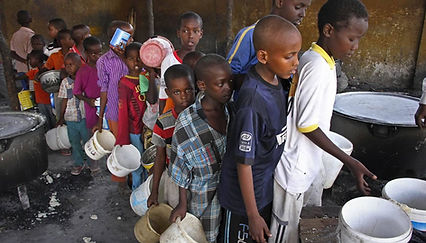
Tragically, this audiovisual storm in a teapot got more attention than a very real famine currently looming in Yemen, Nigeria, South Sudan and Somalia. Currently threatening or affecting more than 20 million people in the latter countries, this impending catastrophe has been described by Stephen O’Brien, the UN under-secretary-general for humanitarian affairs, as the worst humanitarian crisis since World War II [2]. However, the story has received far less coverage than events occurring in Western countries, with for example Google News displaying on its first page of results when searching for the keyword “famine” two links out of ten covering the imminent famine and five covering the aforementioned British-Irish televisual feud.
This disparity follows political fault lines regimenting the flow and content of information. It ascribes waning values to human lives as the cultural distances grow. Exacerbated by inherited colonial notions of the African/Arab as the other, the multiple, or even the too many, the bound to fail, it has created a feeling of remoteness and a situation of ignorance in potential donors. Indeed, the inexistent or helplessly pessimistic discourse does not stimulate empathy. This situation means that only 39% of the $4.9 billion required in 2017 by the United Nations Office for the Coordination of Humanitarian Affairs (OCHA) to provide life-saving assistance in these four countries has been funded [3]. The essential goal of this text will, therefore, be to suggest new ways of increasing traffic of stories covering humanitarian issues, but also and more importantly, their efficiency.
From ignorance to strong commitment
The intuitions we made earlier relating to the “Victoria” episode may well show us a path to follow towards a more efficient reaction to humanitarian crises. Indeed, the main hurdle in funding the Humanitarian Response Plan as outlined by Carolyn Miles, the president and chief executive of Save the Children, is raising awareness. “We can’t seem to get anyone’s attention to what’s going on”, she deplores [4]. However, a recent study by the International Rescue Committee conducted on 1351 American registered voters collected evidence that might prove conducive to devising better communication and funding strategies. It establishes that, much like the “Victoria” situation, ignorance is followed by strong emotional engagement with the issue. Indeed, the poll shows that only 15% of Americans are aware of the crisis, but that after being briefed, 73% rank it as one of the five issues that are most concerning to them [5].
One might challenge the validity of the findings as confined to only one country and failing to measure the long-term commitment to the issue that might lead to action or donation. However, American foreign aid has a tremendous influence on this crisis, and it has been estimated that the cuts to their budget proposed for 2018 by the Trump administration could more than double the devastation caused by the famine [6]. Furthermore, there is a substantive difference between the proportion of participants aware of the crisis prior to the poll and the proportion of them highly concerned with it after the poll. This might suggest that even if some forget about it, a good section of those made aware will develop a long-term commitment to the crisis. Combine this with another finding of the survey, stating that a majority of American millennials (45%) consider that the US has a moral obligation to provide assistance globally, and it appears that communicating efficiently to this group is the key to a successful response to the situation in South Soudan, Somalia, Nigeria, and Yemen.
Behavioural economics principles at the rescue of humanitarian communication
Now, you might ask, what are the concrete steps to get the information to people in an efficient way? An avenue for action might stand in two unsexy-sounding words: libertarian paternalism. This principle, also known as nudge theory, won Richard Thaler the 2017 Economics Nobel Prize and suggests that a good way to administer the society is to steer the individual into what is considered the right way, in a paternalistic (or maternalistic) fashion. However, it always leaves him the option to make his own decisions. Examples of this in action are manyfold: warnings on packs of tobacco, which deter but don't prohibit smoking, GPS guiding which suggest but does not enforce an itinerary, and so on [7].
The implementation of libertarian paternalism that concerns us is opt-out systems, in which individuals are enrolled by default, but have the freedom to leave. These are used for example in the Austrian organ donation program, meaning that consent is assumed and one must explicitly opt out. The country has an astonishing 99.82% rate of approval, compared to a 12% rate in Germany, which operates on an opt-in system. Other similar opt-out systems have yielded good results in savings plans, tips or voting registration [8].
Tweaking social media algorithms to reach millennials
Why not use this dynamic in information propagation and awareness raising? The IRC poll cited shows an already deep commitment to humanitarian action in millennials. Moreover, millennials have integrated social media as essential component of their lives, as according to a Pew Research Center 2016 study, 88% of American adults aged 18 to 29 use Facebook, and 36% of them use Twitter - there are a lot of other social networks, but lets focus on these two, which seem to have a considerable influence as propagators of news-type information [9]. Finally, we know that these two medias function with algorithms which organise news-feeds, selecting which story, article picture or clip should be shown first. This is especially visible with sponsored content, which gives it an advantage over others for a fee.
One of the solutions in tackling lack of awareness of global crises in potential donors might be to de facto favour stories about these crises in the algorithms, as it would be the case for sponsored content. The paternalistic nudging to act in solidarity would be fulfilled, and the libertarian aspect would consist of the possibility to disable the highlighting of the stories and switch back to the standard algorithm. The operation should be led by a UN organ, for example, the UNOCHA. It should also perform a careful selection of the stories, verifying the claims and ensuring the conciseness, fairness, and informativeness of the reports, increasing the efficiency of the communication and avoiding viewers becoming less sensitive to the message. Global news agencies such as the AFP and Reuters could help collecting data demonstrating the need for action or donation. Facebook and Twitter might be reluctant in modifying their algorithm. However, the prospect of improving their public image, smeared by trolls and censorship, might be a sufficient incentive to find a compromise.
The tragedy of the famine unfolding in Somalia, Nigeria, Yemen and South Sudan is only matched by that of the apparent standstill of those who could make a difference. Be it caused by lack of information or desensitisation, this troubling dynamic will only increase as the famine unravels. My suggestion of applying nudge theory to algorithms will ensure that these events get more coverage, and therefore increase the grassroots response to them, while ensuring the freedom to “opt-out” is preserved. Of course, essential issues such as freedom of the press in these countries cannot be fully addressed in this short paper. However, the increased coverage might lead viewers to urge their governments to put pressure on those countries to stop them from trying to cover up the situation, as well as strengthen local activism.
[1] Rte.ie, (2017), British TV viewers shocked by Famine scenes in Victoria, accessed at: https://www.rte.ie/entertainment/2017/1003/909290-british-tv-viewers-shocked-by-famine-scenes-in-victoria/
[2] The Guardian.com Associated Press, (2017), World faces worst humanitarian crisis since 1945, says UN official, accessed at: https://www.theguardian.com/world/2017/mar/11/world-faces-worst-humanitarian-crisis-since-1945-says-un-official
[3] United Nations Office for the Coordination of Human Affairs – Geneva, (2017), Funding Update: Nigeria, South Sudan, Somalia and Yemen, accessed at: https://reliefweb.int/sites/reliefweb.int/files/resources/Somalia%20Nigeria%20South%20Sudan%20Yemen%20funding%20update%209%20June%20final.pdf
[4] Diehl, J. (2017), No one is paying attention to the worst humanitarian crisis since World War II, accessed at: https://www.washingtonpost.com/opinions/global-opinions/no-one-is-paying-attention-to-the-worst-humanitarian-crisis-since-world-war-ii
[5] International Rescue Committee, (2017), IRC poll: ending famine is defining issue for millennials, accessed at: https://www.rescue.org/press-release/irc-poll-ending-famine-defining-issue-millennials
[6] Diehl, J. (2017), No one is paying attention to the worst humanitarian crisis since World War II, accessed at: https://www.washingtonpost.com/opinions/global-opinions/no-one-is-paying-attention-to-the-worst-humanitarian-crisis-since-world-war-ii
[7] Sunstein, C. (2017), Libertarian Paternalism: Eat Well, Retire Rich, and Feel the Freedom, accessed at: http://bigthink.com/videos/cass-sunstein-libertarian-paternalism-eat-well-retire-rich-and-feel-the-freedom
[8] Thaler, R. (2009), Opting in vs. Opting out, accessed at: http://www.nytimes.com/2009/09/27/business/economy/27view.html
[9] Greenwood, S., Perrin, A., Duggan, M. (2016), Social Media Update 2016, accessed at: http://www.pewinternet.org/2016/11/11/social-media-update-2016/